Showing posts with label brain teasers. Show all posts
Saturday, May 27, 2017
Letter Groupings
The letters of the (English) alphabet can be grouped into four distinct categories.
A M
B C D E K
F G J L
H I
Based on the categories established by the first 13 letters, can you place each of the remaining 13 letters in the correct group?
Labels:
brain teasers,
puzzles
Saturday, May 20, 2017
Number Words
In the solution to A Unique Number, I asked a bonus question. "Can you think of a number whose letters when spelled out in English are all in alphabetical order?" Several people replied via Twitter with the correct answer of "forty." You may have found a shortcut to the solution if you noted that none of the single-digit numbers have their letters in alphabetical order, nor does the word "teen." This allows you to skip ahead to 20, 30, etc. Can you use a similar strategy to answer the following questions?
- What is the lowest number that requires the five vowels A, E, I, O, and U only once each in its spelling?
- What is the lowest number that requires the six letters A, E, I, O, U, and Y only once each in its spelling?
The lowest number that requires the five vowels A, E, I, O, and U once each in its spelling is 206 (two-hundred and six).
The lowest number that requires the six letters A, E, I, O, U, and Y once each in its spelling is 230 (two-hundred and thirty).
The strategy to quickly find these answers is to note which vowels are used in the base numbers, one, two, three, etc, then avoid combinations that include multiples of the same vowel. For example, you can skip past the 100s entirely, because "one-hundred" contains two of the letter "e".
Labels:
brain teasers,
numbers,
puzzles
Saturday, April 29, 2017
Common Thread
What do the following words have in common?
- dust
- seed
- left
- resign
- weather
- sanction
Each word has at least two meanings, and in each case one of those meanings is the opposite of the other.
For these and more, see the Mental Floss article 25 Words That Are Their Own Opposites.
- dust - as a verb can mean either to add or remove something.
- seed - also means either to add or remove something. If you seed the lawn you add seeds, but if you seed a tomato you remove them.
- left - can mean either remaining or departed.
- resign - can mean "to quit" but can also mean "to sign up again."
- weather - can mean "to withstand or make through" (weather the storm) or can mean "to be worn away."
- sanction - can mean 'give official permission or approval for (an action)' or conversely, 'impose a penalty on.'
For these and more, see the Mental Floss article 25 Words That Are Their Own Opposites.
Labels:
brain teasers,
puzzles
Saturday, April 22, 2017
Marking a Ruler
A 13-inch ruler only needs four markings on it so that it can be used to measure any whole number of inches from 1 to 13. At what positions should the four markings be? (Do not include the two ends, which are understood to be markings 0 and 13.) Click below to see the answer.
The markings should be at the 1, 2, 6, and 10-inch positions. Use the following markings to measure each whole-number length:
1 inch: 0 to 1
2 inches: 0 to 2
3 inches: 10 to 13
4 inches: 2 to 6
5 inches: 1 to 6
6 inches: 0 to 6
7 inches: 6 to 13
8 inches: 2 to 10
9 inches: 1 to 10
10 inches: 0 to 10
11 inches: 2 to 13
12 inches: 1 to 13
13 inches: 0 to 13
1 inch: 0 to 1
2 inches: 0 to 2
3 inches: 10 to 13
4 inches: 2 to 6
5 inches: 1 to 6
6 inches: 0 to 6
7 inches: 6 to 13
8 inches: 2 to 10
9 inches: 1 to 10
10 inches: 0 to 10
11 inches: 2 to 13
12 inches: 1 to 13
13 inches: 0 to 13
Labels:
brain teasers,
puzzles
Saturday, March 4, 2017
A Unique Number
What is unique about the number 8,549,176,320? Click below to see the answer (and a bonus question).
There's nothing numerically particularly unique or interesting about the number above. It is made up of all of the digits from 0 to 9, but a lot of numbers have that property. The unique thing about this number is that all of the digits from 0 to 9 are in alphabetical order when spelled out in English.
Bonus question: Can you think of a number whose letters when spelled out in English are all in alphabetical order? Example: The first three letters of the word "five" are in alphabetical order, but the "e" at the end spoils it.
Labels:
brain teasers,
numbers,
puzzles
Saturday, February 25, 2017
Best Poker Hand
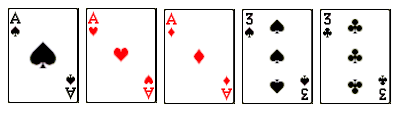
Which of the following poker hands is the best? Assume one standard 52-card deck is used. The game is five-card draw, so there are no community cards, with no wild cards.
For reference, here are the rankings of poker hands.
- Royal flush - A, K, Q, J, 10, all the same suit.
- Straight flush - Five cards in a sequence, all the same suit.
- Four of a kind - Four cards all of the same rank.
- Full house - Three of a kind with a side pair.
- Flush - Any five cards, all the same suit
- Straight - Five cards in a sequence, any suits.
- Three of a kind - Three cards all of the same rank.
- Two pair - Two different pairs.
- One pair - Two cards of the same rank.
- High card - Highest card in your hand.
Click below to see the answer.
Hand #1 is the highest-ranking hand shown, but since all of these hands cannot occur on the same deal, it isn't the best hand to have in a real game.
To determine which hand is best, you have to look at how many other hands can beat each hand when dealt from the same deck. All of the hands above can be beaten by the same number of four-of-a-kinds, but by different numbers of straight flushes. Having two sixes as your side pair breaks up more of these possible straight flushes than having two kings, so hand #4 is actually the best hand to have. (There are 32 possible straight flushes that beat the kings hand, but only 24 that beat the sixes.)
Labels:
brain teasers,
logic,
puzzles
Saturday, February 18, 2017
The Collapsing Bridge
The bridge will collapse in 17 minutes! Four people need to cross the bridge before it collapses. It is a dark night and they have only one flashlight among them.
Only two people can cross at a time.
- Alice takes one minute to cross.
- Bob takes two minutes.
- Carol takes five minutes
- Dave takes 10 minutes to cross.
The trick to this puzzle is to get the slowest members of the group to cross only once together, while the fastest members cross back and forth multiple times.
- Alice and Bob cross first using up 2 minutes.
- Alice comes back making it 3.
- Carol and Dave cross together making it 13 minutes.
- Then Bob crosses back, making it 15 minutes.
- Finally, Alice and Bob cross together to make it a total of 17 minutes.

Labels:
brain teasers,
logic puzzles,
math
Saturday, February 4, 2017
Animal Kingdom
What do the following animals all have in common?
- firefly
- jackrabbit
- koala bear
- prairie dog
- silkworm
- guinea pig
Click below to see the answer.
All of the animals listed above are impostors.
- The firefly is not a fly. It is a beetle.
- The jackrabbit is not a rabbit. It is a hare.
- The koala is not a bear. It is a marsupial.
- The prairie dog is not a dog. It is a rodent.
- The silkworm is not a worm. It is a caterpillar.
- The guinea pig is not a pig. It is a rodent. (And it's not even from Guinea, a country on the west coast of Africa. Guinea pigs originated in the Andes mountains in South America.)
Labels:
brain teasers,
puzzles
Saturday, January 28, 2017
Name this Book
When this book first came out, it was only read by a handful of rather wealthy people. Now almost everyone has a copy, and many people read it regularly. You cannot buy it from a bookstore or borrow it from the library. Can you name this book? Click below for the answer.
It's a phone book.

This is a good example of an old riddle that has not aged well, so don't feel bad if you found it a bit tricky. Newer technology has rendered phone books practically useless, yet I still get one delivered to my house every year. In another generation or so, many people might not know what they were used for.

This is a good example of an old riddle that has not aged well, so don't feel bad if you found it a bit tricky. Newer technology has rendered phone books practically useless, yet I still get one delivered to my house every year. In another generation or so, many people might not know what they were used for.
Labels:
brain teasers,
puzzles,
riddles
Subscribe to:
Posts (Atom)