Showing posts with label programming. Show all posts

Monday, August 22, 2016

Twitter's Favorite Films

If you were on Twitter at all last week, you probably couldn't help but notice a flurry of "Fav7" hashtags trending, including #Fav7Films, #Fav7Books, #Fav7TVShows where people were posting a list of their favorite 7 things from each category.


I thought it would be fun to scrape the data to see what Twitter's favorite films are, and compare it to the top rated films on IMDb and Rotten Tomatoes. Here are the results.

Twitter's Top 25 Films
  1. The Dark Knight (9.0 IMDb, 94% RT)
  2. Pulp Fiction (8.9 IMDb, 94% RT)
  3. The Empire Strikes Back (8.8 IMDb, 94% RT)
  4. Goodfellas (8.7 IMDb, 96% RT)
  5. The Shawshank Redemption (9.3 IMDb, 91% RT)
  6. Fight Club (8.8 IMDb, 79% RT)
  7. The Godfather (9.2 IMDb, 99% RT)
  8. Back to the Future (8.5 IMDb, 96% RT)
  9. Inception (8.8 IMDb, 86% RT)
  10. Jurassic Park (8.1 IMDb, 93% RT)
  11. Forrest Gump (8.8 IMDb, 72% RT)
  12. The Big Lebowski (8.2 IMDb, 81% RT)
  13. Jaws (8.0 IMDb, 97% RT)
  14. Star Wars (8.7 IMDb, 93% RT)
  15. Raiders of the Lost Ark (8.5 IMDb, 94% RT)
  16. The Princess Bride (8.1 IMDb, 97% RT)
  17. Blade Runner (8.2 IMDb, 89% RT)
  18. Alien (8.5 IMDb, 97% RT)
  19. The Departed (8.5 IMDb, 91% RT)
  20. The Matrix (8.7 IMDb, 87% RT)
  21. Interstellar (8.6 IMDb, 71% RT)
  22. Aliens (8.4 IMDb, 98% RT)
  23. Good Will Hunting (8.3 IMDb, 97% RT)
  24. The Shining (8.4 IMDb, 88% RT)
  25. Die Hard (8.2 IMDb, 92% RT)

A few observations:

  • Less than half of the films in Twitter's top 25 are also in IMDb's top 25.
  • The Godfather (1972) is the oldest film on the list, while Interstellar (2014) is the newest.
  • Harrison Ford has starred in the most (4) of the top 25 films, while Stephen Spielberg has directed the most (3).
  • Only three sequels appear in the top 25. For two of those, the original film also appears in the top 25.
  • Action/adventure and science fiction films dominate the list.
  • As popular as they are right now, only one film based on a comic book character is in the top 25 (although it did take the top spot).

The source code

Start by loading the required libraries, including twitteR for accessing the Twitter API, and setting up authentication. You'll need to sign up for free on Twitter Developers to get your own authentication keys and tokens. (If you've never done this before, see Bogdan Rau's Collecting Tweets Using R and the Twitter Search API for a more detailed guide.)

library(dplyr)
library(purrr)
library(twitteR)

# Download cacert file for Windows use.
download.file(url="http://curl.haxx.se/ca/cacert.pem", destfile="cacert.pem")

consumer_key <- 'your key'
consumer_secret <- 'your secret'
access_token <- 'your access token'
access_secret <- 'your access secret'
setup_twitter_oauth(consumer_key,
                    consumer_secret,
                    access_token,
                    access_secret)

Next, query the Twitter search API for the "#Fav7Films" hashtag, and initialize a data frame with tweets.

requests <- 1 # keep count of how many requests are sent
num_tweets <- 3000 # number of tweets to fetch per request
delay <- 62.0 # add in a delay so the API doesn't block

fav_film_tweets <- searchTwitter("#Fav7Films\n", n=num_tweets)
Sys.sleep(delay) # be nice to the API
fav_film_df <- tbl_df(map_df(fav_film_tweets, as.data.frame))

fav_film_all <- fav_film_df[fav_film_df$isRetweet == FALSE, ]

Now we want to keep searching in a loop, until we've downloaded all the tweets we're interested in. To do that, we'll keep looping as long as the API returns as many tweets as we told it to. Once it returns fewer tweets, we know it ran out.

while(nrow(fav_film_df) == num_tweets) {
    max_id <- fav_film_df$id[num_tweets]
    requests <- requests + 1
    fav_film_tweets <- searchTwitter("#Fav7Films\n", n=num_tweets, maxID=max_id)
    fav_film_df <- tbl_df(map_df(fav_film_tweets, as.data.frame))
    fav_film_all <- rbind(fav_film_all, fav_film_df[fav_film_df$isRetweet == FALSE, ])

    Sys.sleep(delay) # be nice to the API
}

Note that I added the maxID=max_id parameter to the request. This tells the search API to return tweets older than the previous set of tweets. Also note that I added a delay in the loop. Twitter has set a rate limit on their search API to 15 requests every 15 minutes, so this delay is to avoid being blocked.

That will take a while, but once it's done we'll have over 100,000 tweets, so we want to save them so we don't have to go through all that again. I just saved the whole data frame to an R data blob.

save(fav_film_all, file="Fav7FilmTweets.Rda")

You can download that file from GitHub at Fav7FilmTweets.Rda if you want to follow along from this point, or if you want to do your own analysis on this data set. Just use load("Fav7FilmTweets.Rda") to load the data frame from the file.

Next, we want to remove any retweets or multiple tweets from the same user.

fav_film_all <- fav_film_all[fav_film_all$isRetweet == FALSE, ]
fav_film_all <- fav_film_all[!duplicated(fav_film_all$screenName), ]

Now we can start parsing the lists of film titles from the tweets. Most people formatted their titles on separate lines, so we'll assume that format. Any tweets that don't use that format will just fall to the bottom of the list of films once we rank them.

# remove the hashtag, ignoring case
fav_film_all$text <- gsub("#fav7films", "", fav_film_all$text, ignore.case=TRUE)

# remove numbers from lists
fav_film_all$text <- gsub("\\d\\.|\\)|-", "", fav_film_all$text)

# convert to common case for all tweets
fav_film_all$text <- tolower(fav_film_all$text)

# trim any whitespace left over from earlier steps
fav_film_all$text <- trimws(fav_film_all$text)

At this point, we should have a bunch of lists of seven movie titles. What we want to do next is separate them all out into one large list of titles, count how many times each title appears, then sort the list. We'll also remove "A" and "The" from the beginning of any titles that include them, since many people included them, but many didn't.

titles <- list()
titles <- append(titles, strsplit(fav_film_all$text, split="\n"))
titles <- unlist(titles)

# remove leading 'a' and 'the' from titles
titles <- gsub("^a ", "", titles)
titles <- gsub("^the ", "", titles)

# remove empty titles
titles <- titles[titles != ""]

ranked_titles <- sort(table(titles), decreasing=TRUE)
top_25 <- head(ranked_titles, 25)

That's the final list. There are a lot of other conditioning steps that we could have taken, like looking for common abbreviations or misspellings, but I think this gets us pretty close to an accurate list.

You can view the full R source code that I used to gather and analyze tweets for this project in my Fav7 GitHub repository. Feel free to fork that and use it to analyze other Twitter favorites, and leave me a comment if you do, or if you have any questions.

Monday, August 15, 2016

How to Ask a Question on Stack Overflow, a Minimal Guide

"How do I ask a question on Stack Overflow without having it immediately downvoted and closed?" This question is frequently asked by new users on Meta Stack Overflow, and people still seem to have issues with the official guidelines, so maybe a shorter, to-the-point guide will help.

Assuming your question is on-topic, there are three things you need to include when posting a question on Stack Overflow:

1. What your program is supposed to do
2. Your code
3. What your program is actually doing

If you leave any of those three things out, people will have trouble answering your question, so they'll often downvote it and vote to close it instead of trying to answer it.  (Ok, I admit it. It's me. I'm the one downvoting you.) Let's take a closer look at each one of these things, and maybe I can convince you why each one is important.

What your program is supposed to do

You need to include an explanation of what you are trying to do in your question. Without it, people are not going to be able to start helping you. Don't just assume that people will understand from the title or context what you're trying to do. Spell it out. If you help people understand your problem, they're much more able to help you with a solution.

Your code

Does every question on Stack Overflow require code? No. But the majority of them do. Most often, people are going to need to be able to run your code in order to help you. If you have code, you need to post it. If you're going to write code and you don't know where to start, you need to start before asking about it on Stack Overflow. Don't post a link to your code. Don't post an image of your code. Post your code.

What your program is actually doing

Describe how your program is acting differently than you expect (What your program is supposed to do). Not including this information leaves people guessing about what the problem actually is. Does your code not even compile? Give the wrong output? Print an error message? Lock up your machine and set fire to the building? Each one of these very different behaviors will point an experienced developer to the solution much more quickly than just reading your code. Include any output, including the text of any error messages in your question. Those cryptic error messages might not mean anything to you, but a more experienced programmer can lead you directly to the problem if they know all of the details.

Is that really all I need?

No, not really, but this covers the majority of the questions that I see closed and downvoted on Stack Overflow. If you follow these guidelines, you should have far fewer problems with getting your questions answered. Once you've mastered just asking a question and not getting it closed, you should read some more complete guides on asking great questions, like Jon Skeet's Writing the Perfect Question.


Tuesday, April 30, 2013

SICP 2.66: Sets and information retrieval

From SICP section 2.3.3 Sets and information retrieval

The final part of section 2.3.3 asks us to consider a database that contains records, each of which has a key and some data. If the database is represented as an unordered list, a record can be looked up by its key using the following procedure.

(define (lookup given-key set-of-records)
  (cond ((null? set-of-records) false)
        ((equal? given-key (key (car set-of-records)))
         (car set-of-records))
        (else (lookup given-key (cdr set-of-records)))))

We can define simple procedures for making a record out of a key and its data, and for extracting the key and data from an existing record in order to test the procedure above.

(define (key record) (car record))
(define (data record) (cdr record))
(define (make-record key data) (cons key data))

(define database
  (list (make-record 1 'Bill)
        (make-record 2 'Joe)
        (make-record 3 'Frank)
        (make-record 4 'John)))
  
> (lookup 3 database)
'(3 . Frank)
> (data (lookup 1 database))
'Bill

Exercise 2.66 asks us to implement the lookup procedure for the case where the set of records is structured as a binary tree, ordered by the numerical values of the keys.

We can start by including the list->tree and partial-tree procedures given for exercise 2.64, along with a few required supporting procedures.

(define (entry tree) (car tree))
(define (left-branch tree) (cadr tree))
(define (right-branch tree) (caddr tree))
(define (make-tree entry left right)
  (list entry left right))
  
(define (list->tree elements)
  (car (partial-tree elements (length elements))))

(define (partial-tree elts n)
  (if (= n 0)
      (cons '() elts)
      (let ((left-size (quotient (- n 1) 2)))
        (let ((left-result (partial-tree elts left-size)))
          (let ((left-tree (car left-result))
                (non-left-elts (cdr left-result))
                (right-size (- n (+ left-size 1))))
            (let ((this-entry (car non-left-elts))
                  (right-result (partial-tree (cdr non-left-elts)
                                              right-size)))
              (let ((right-tree (car right-result))
                    (remaining-elts (cdr right-result)))
                (cons (make-tree this-entry left-tree right-tree)
                      remaining-elts))))))))

This makes it easier to convert the existing database to one structured as a binary tree.

> (define tree-db (list->tree database))
> tree-db
'((2 . Joe) ((1 . Bill) () ()) ((3 . Frank) () ((4 . John) () ())))

Finally, we can write the new implementation of lookup using element-of-set? as a guide.

(define (lookup given-key set-of-records)
  (cond ((null? set-of-records) #f)
        ((= given-key (key (car set-of-records)))
         (car set-of-records))
        ((< given-key (key (car set-of-records)))
         (lookup given-key (left-branch set-of-records)))
        ((> given-key (key (car set-of-records)))
         (lookup given-key (right-branch set-of-records)))))

> (lookup 3 tree-db)
'(3 . Frank)
> (lookup 1 tree-db)
'(1 . Bill)
> (lookup 5 tree-db)
#f
> (data (lookup 2 tree-db))
'Joe

For links to all of the SICP lecture notes and exercises that I've done so far, see The SICP Challenge.

Sunday, March 24, 2013

SICP 2.63 - 2.65: Sets as binary trees

From SICP section 2.3.3 Example: Representing Sets

So far in this section we've looked at two ways of representing sets. First as unordered lists, then as ordered lists. Now we'll look at how we can represent sets as binary trees, and we'll see what advantages this representation has over ordered lists.

Each node of a tree holds one element of the set, called the "entry" at that node, and a link to each of two other (possibly empty) nodes. The "left" link points to elements smaller than the one at the node, and the "right" link to elements greater than the one at the node. The same set may be represented by a number of different trees. The only requirements for a valid representation is that all elements in the left subtree must be smaller than the node entry and all elements in the right subtree be must be larger than the node entry. Figure 2.16 in the text shows several valid tree representations of the same set of values.


Recall that for an ordered set of n elements, we had to search through (on average) n/2 elements to locate a particular value. We do this by searching through the elements in order. The advantage of a tree representation is that we can cut this effort down to log n if the tree is balanced.


Exercise 2.63 asks us if the following two procedures produce the same results for every tree, and if not how they differ.

(define (tree->list-1 tree)
  (if (null? tree)
      '()
      (append (tree->list-1 (left-branch tree))
              (cons (entry tree)
                    (tree->list-1 (right-branch tree))))))
     
(define (tree->list-2 tree)
  (define (copy-to-list tree result-list)
    (if (null? tree)
        result-list
        (copy-to-list (left-branch tree)
                      (cons (entry tree)
                            (copy-to-list (right-branch tree)
                                          result-list)))))
  (copy-to-list tree '()))

The tree->list-1 procedure checks to see if the tree passed in is null, and if so returns an empty list. If the tree is not null, it creates a list by appending the left branch of the tree, the element at the root node, and the right branch of the tree. Elements of the left and right branches are flattened into lists using recursive calls to tree->list-1. The tree->list-2 procedure defines a helper function copy-to-list that takes the tree and a result-list as arguments. When the tree is null, it returns the result-list that was passed in. The copy-to-list helper function also uses recursive calls to the left and right branches of the tree while building the final result list. These two procedures will produce the same results for every tree.

We're asked to test the two procedures on the trees in figure 2.16.

(define tree1 '(7 (3 (1 () ()) (5 () ())) (9 () (11 () ()))))
(define tree2 '(3 (1 () ()) (7 (5 () ()) (9 () (11 () ())))))
(define tree3 '(5 (3 (1 () ()) ()) (9 (7 () ()) (11 () ()))))

> (tree->list-1 tree1)
'(1 3 5 7 9 11)
> (tree->list-2 tree1)
'(1 3 5 7 9 11)
> (tree->list-1 tree2)
'(1 3 5 7 9 11)
> (tree->list-2 tree2)
'(1 3 5 7 9 11)
> (tree->list-1 tree3)
'(1 3 5 7 9 11)
> (tree->list-2 tree3)
'(1 3 5 7 9 11)

We can see from these results that both procedures return an in-order traversal for every tree.

We're also asked if the two procedures have the same order of growth for a balanced tree, and if not, which one grows more slowly?

We can see from the results above and from inspecting the two procedures that each node of the tree is visited one time by each algorithm. What happens at each of those n steps is subtly different though. The second procedure simply calls cons at each step, which we'll assume is a constant-time operation, so the tree->list-2 procedure has a time complexity of $O(n)$. The first procedure calls append at each step, which we saw in section 2.2.1 has the following definition:

(define (append list1 list2)
  (if (null? list1)
      list2
      (cons (car list1) (append (cdr list1) list2))))

From this definition we can see that the order of growth of append is proportional to the first list argument that's passed in. In the case of tree->list-1, the first list argument is the left branch of the tree, which is about half of a node's elements for a balanced tree. This means that for each recursive call, approximately half of the number of nodes will be in the first list argument as in the previous call. Since the number of elements is cut in half on each of the n calls to append, the tree->list-1 procedure has a complexity of $O(n log n)$ for a balanced tree.


Exercise 2.64 introduces the list->tree procedure, which converts an ordered list to a balanced binary tree using the helper procedure partial-tree that takes as arguments an integer n and list of at least n elements and constructs a balanced tree containing the first n elements of the list.

(define (list->tree elements)
  (car (partial-tree elements (length elements))))

(define (partial-tree elts n)
  (if (= n 0)
      (cons '() elts)
      (let ((left-size (quotient (- n 1) 2)))
        (let ((left-result (partial-tree elts left-size)))
          (let ((left-tree (car left-result))
                (non-left-elts (cdr left-result))
                (right-size (- n (+ left-size 1))))
            (let ((this-entry (car non-left-elts))
                  (right-result (partial-tree (cdr non-left-elts)
                                              right-size)))
              (let ((right-tree (car right-result))
                    (remaining-elts (cdr right-result)))
                (cons (make-tree this-entry left-tree right-tree)
                      remaining-elts))))))))

First we're asked to explain how partial-tree works, then draw the tree produced by list->tree for the list (1 3 5 7 9 11).

The partial-tree procedure works by dividing the list into three parts, a center element (the root node of the tree), everything before the center element, and everything after the center element. All the elements before the center element are then passed to a recursive call to partial-tree to create the left branch of the tree, and all the elements after the center element are passed recursively to partial-tree to create the right branch. These recursive call continue until no elements are remaining, and the balanced binary tree is assembled.

The tree produced by list->tree for the list (1 3 5 7 9 11) is:


To verify this, we can simply call the procedure.

> (list->tree '(1 3 5 7 9 11))
'(5 (1 () (3 () ())) (9 (7 () ()) (11 () ())))

Next we're asked what is the order of growth in the number of steps required by list->tree to convert a list of n elements? The procedure only needs to visit each element of the list once, and it only performs a cons for each element it visits, so the number of steps is proportional to the size of the list, or $O(n)$.


Exercise 2.65 asks us to use the results of the previous two exercises to give $O(n)$ implementations of union-set and intersection-set for sets implemented as (balanced) binary trees.

We implemented union-set for the unordered list representation of sets back in exercise 2.59. This implementation had to check all elements of one set for each element of the other, so it's complexity was $O(n^2)$, quite poor. We improved on this in exercise 2.62 when we wrote an implementation of union-set for the ordered list representation of sets, which was $O(n)$. The text supplied a similar implementation of intersection-set that was also $O(n)$. We could use these ordered set implementations as a guide to writing efficient implementations of union-set and intersection-set for balanced binary trees, but that wouldn't require the results of the previous two exercises. Instead, we can use the $O(n)$ implementations of all of the procedures we've built so far to perform the following steps:

  • Convert the balanced binary trees to ordered lists.
  • Perform the desired operation (union-set or intersection-set).
  • Convert the resulting ordered set back to a balanced binary tree.

(define (union-set tree1 tree2)
  (define (union-list set1 set2)
    (cond ((null? set1) set2)
          ((null? set2) set1)
          ((= (car set1) (car set2))
           (cons (car set1) (union-list (cdr set1) (cdr set2))))
          ((< (car set1) (car set2))
           (cons (car set1) (union-list (cdr set1) set2)))
          (else (cons (car set2) (union-list set1 (cdr set2))))))
  (list->tree (union-list (tree->list-2 tree1)
                          (tree->list-2 tree2))))

(define (intersection-set tree1 tree2)
  (define (intersection-list set1 set2)
    (if (or (null? set1) (null? set2))
        '()    
        (let ((x1 (car set1)) (x2 (car set2)))
          (cond ((= x1 x2)
                 (cons x1
                       (intersection-list (cdr set1)
                                          (cdr set2))))
                ((< x1 x2)
                 (intersection-list (cdr set1) set2))
                ((< x2 x1)
                 (intersection-list set1 (cdr set2)))))))
  (list->tree (intersection-list (tree->list-2 tree1)
                                 (tree->list-2 tree2))))

In the implementations above, I've just defined the earlier ordered set implementations of union-set and intersection-set as helper functions named union-list and intersection-list. With these helper functions, all union-set and intersection-set need to do is convert from tree to list and back from list to tree. We can define a few balanced trees to test that these new implementations work as expected.

> (define evens (list->tree '(0 2 4 6 8 10)))
> (define odds (list->tree '(1 3 5 7 9)))
> (define primes (list->tree '(2 3 5 7 11 13 17 19)))
>
> evens
'(4 (0 () (2 () ())) (8 (6 () ()) (10 () ())))
> odds
'(5 (1 () (3 () ())) (7 () (9 () ())))
> primes
'(7 (3 (2 () ()) (5 () ())) (13 (11 () ()) (17 () (19 () ()))))
>
> (union-set odds evens)
'(5
  (2 (0 () (1 () ())) (3 () (4 () ())))
  (8 (6 () (7 () ())) (9 () (10 () ()))))
> (union-set odds odds)
'(5 (1 () (3 () ())) (7 () (9 () ())))
> (intersection-set evens primes)
'(2 () ())
> (intersection-set odds primes)
'(5 (3 () ()) (7 () ()))
> (intersection-set odds evens)
'()


For links to all of the SICP lecture notes and exercises that I've done so far, see The SICP Challenge.

Saturday, September 1, 2012

12 (Really) Controversial Programming Opinions

A few days ago, Yannis Rizos posted 20 controversial programming opinions on the Programmers Community Blog. Judging by the comments on the blog, and on reddit and Hacker News, none of these opinions are considered all that controversial by the programming community at large. The problem stems from the fact that the opinions posted were selected from among the top-voted answers to Jon Skeet’s question What’s your most controversial programming opinion?, originally asked on Stack Overflow on January 2, 2009. People seem to have voted for answers they strongly agreed with, making those top answers some of the least controversial opinions you could gather.

I decided to take a different approach. What follows are some of the opinions that I found near the middle or at the end of the list. I tried to pick only answers where the author made an attempt at supporting their opinion, but as you can see some of these opinions were downvoted more heavily than they were upvoted by the Stack Overflow community. (I'll add that my own "controversial" opinion is that Jon's question is perhaps the best argument we have that these types of opinion polls simply do not work on Stack Overflow.)

1. Two lines of code is too many. (+20/-32) by Jay Bazuzi

If a method has a second line of code, it is a code smell. Refactor.

2. If it's not native, it's not really programming (+5/-15) by Mason Wheeler

By definition, a program is an entity that is run by the computer. It talks directly to the CPU and the OS. Code that does not talk directly to the CPU and the OS, but is instead run by some other program that does talk directly to the CPU and the OS, is not a program; it's a script. Read more

3. The "While" construct should be removed from all programming languages. (+6/-14) by seanyboy

You can easily replicate While using "Repeat" and a boolean flag, and I just don't believe that it's useful to have the two structures. In fact, I think that having both "Repeat...Until" and "While..EndWhile" in a language confuses new programmers. Read more

4. Copy/Pasting is not an antipattern, it fact it helps with not making more bugs (+4/-5) by serg

My rule of thumb - typing only something that cannot be copy/pasted. If creating similar method, class, or file - copy existing one and change what's needed. (I am not talking about duplicating a code that should have been put into a single method). Read more

5. Developing on .NET is not programming. Its just stitching together other people's code. (+7/-5) by Gerard

Having come from a coding background where you were required to know the hardware, and where this is still a vital requirements in my industry, I view high level languages as simply assembling someone else's work. Nothing essentially wrong with this, but is it 'programming'? Read more

6. The use of try/catch exception handling is worse than the use of simple return codes and associated common messaging structures to ferry useful error messages. (+11/-3) by Einstein

Littering code with try/catch blocks is not a solution.

Just passing exceptions up the stack hoping whats above you will do the right thing or generate an informative error is not a solution. Read more

7. Test Constantly (+15/-7) by PJ Davis

You have to write tests, and you have to write them FIRST. Writing tests changes the way you write your code. It makes you think about what you want it to actually do before you just jump in and write something that does everything except what you want it to do. Read more

8. Object Oriented Programming is absolutely the worst thing that's ever happened to the field of software engineering. (+34/-14) by Breton

The primary problem with OOP is the total lack of a rigorous definition that everyone can agree on. This easily leads to implementations that have logical holes in them, or language like Java that adhere to this bizarre religious dogma about what OOP means, while forcing the programmer into doing all these contortions and "design patterns" just to work around the limitations of a particular OOP system. Read more

9. C (or C++) should be the first programming language (+24/-5) by hansen j

The first language should NOT be the easy one, it should be one that sets up the student's mind and prepare it for serious computer science.
C is perfect for that, it forces students to think about memory and all the low level stuff, and at the same time they can learn how to structure their code (it has functions!)

C++ has the added advantage that it really sucks :) thus the students will understand why people had to come up with Java and C#.

10. Classes should fit on the screen. (+22/-7) by Jay Bazuzi

If you have to use the scroll bar to see all of your class, your class is too big.

Code folding and miniature fonts are cheating.

11. Making invisible characters syntactically significant in python was a bad idea (+43/-5) by Paul Wicks

It's distracting, causes lots of subtle bugs for novices and, in my opinion, wasn't really needed. About the only code I've ever seen that didn't voluntarily follow some sort of decent formatting guide was from first-year CS students. And even if code doesn't follow "nice" standards, there are plenty of tools out there to coerce it into a more pleasing shape.

12. Singletons are not evil (+42/-7) by Steve

There is a place for singletons in the real world, and methods to get around them (i.e. monostate pattern) are simply singletons in disguise. For instance, a Logger is a perfect candidate for a singleton. Additionally, so is a message pump. My current app uses distributed computing, and different objects need to be able to send appropriate messages. There should only be one message pump, and everyone should be able to access it. The alternative is passing an object to my message pump everywhere it might be needed and hoping that a new developer doesn't new one up without thinking and wonder why his messages are going nowhere. The uniqueness of the singleton is the most important part, not its availability. The singleton has its place in the world.

Sunday, July 1, 2012

SICP 2.61 - 2.62: Sets as ordered lists

From SICP section 2.3.3 Example: Representing Sets

In exercises 2.59 and 2.60 we looked at how to represent sets as unordered lists. In the next two we'll look at representing sets as ordered lists, and at what benefits we get from the new implementation.

First, if elements in a set are guaranteed to be in order, we can improve the performance of element-of-set by returning false as soon as we encounter an element of the set that's less than the value that we're looking for. All of the remaining elements are guaranteed to be smaller as well. This saves us on average half the number of comparisons from the previous implementation.
(define (element-of-set? x set)
  (cond ((null? set) false)
        ((= x (car set)) true)
        ((< x (car set)) false)
        (else (element-of-set? x (cdr set)))))
We get a more impressive improvement from intersection-set. In the old implementation using unordered lists we had to compare every element of each set to every element in the other set. This had a complexity of $O(n^2)$. With the elements of both sets in order we can reduce that all the way down to $O(n)$. This is possible due to the fact that if the car of one ordered set is smaller than the car of another ordered set, it has to be smaller than all the other elements and we can discard it right away.
(define (intersection-set set1 set2)
  (if (or (null? set1) (null? set2))
      '()    
      (let ((x1 (car set1)) (x2 (car set2)))
        (cond ((= x1 x2)
               (cons x1
                     (intersection-set (cdr set1)
                                       (cdr set2))))
              ((< x1 x2)
               (intersection-set (cdr set1) set2))
              ((< x2 x1)
               (intersection-set set1 (cdr set2)))))))
Exercise 2.61 asks us to give an implementation of adjoin-set using the ordered representation. Like element-of-set?, our implementation of adjoin-set should require only half as many steps on average as the unordered representation.

The original implementation of adjoin-set made use of element-of-set? to check and see if the new element was already a member of the set. We no longer need to do this since we need to find the exact position in the set to insert the new element. As we scan through the set looking for the right position, we can simply return the set if we encounter the element we're trying to place.
(define (adjoin-set x set)
  (cond ((null? set) (cons x '()))
        ((= x (car set)) set)
        ((< x (car set)) (cons x set))
        ((> x (car set)) (cons (car set)
                               (adjoin-set x (cdr set))))))
There are several different conditions, and we need to cover them all. First, since we're no longer using element-of-set, we need to check to see if the set itself is null or empty. Second, if the we encounter the element we're trying to add, we can just return the set. Next, if the element we're adding is smaller than the first element of the set, we can simply cons the new element to the beginning of the set. Last, if the new element is greater than the first element of the set, we join the first element followed by the adjoin-set of the new element and the rest of the set.
> (adjoin-set 3 null)
(3)
> (adjoin-set 3 '())
(3)
> (adjoin-set 3 '(3 4 5))
(3 4 5)
> (adjoin-set 3 '(4 5 6))
(3 4 5 6)
> (adjoin-set 3 '(1 2 4 5))
(1 2 3 4 5)
> (adjoin-set 3 '(0 1 2))
(0 1 2 3)
Like element-of-set?, this implementation should only scan through half the set on average before finding the correct insertion point for the new element.

Exercise 2.62 asks us to give a $O(n)$ implementation of union-set for sets represented as ordered lists. Since the two sets are in order, we can simply step through each set comparing the first elements of each. At each step we decide which of the first two elements to place in the resulting set.
(define (union-set set1 set2)
  (cond ((null? set1) set2)
        ((null? set2) set1)
        ((= (car set1) (car set2))
         (cons (car set1) (union-set (cdr set1) (cdr set2))))
        ((< (car set1) (car set2))
         (cons (car set1) (union-set (cdr set1) set2)))
        (else (cons (car set2) (union-set set1 (cdr set2))))))
Anyone familiar with the mergesort algorithm will quickly recognize that this implementation of union-set is almost exactly the same procedure as the merge subroutine. It's purpose is to quickly merge two sorted lists into one. The only difference is that the union-set implementation above only keeps one copy of duplicate elements.
> (define odds '(1 3 5 7))
> (define evens '(2 4 6 8))
> (define primes '(2 3 5 7))
> (union-set odds evens)
(1 2 3 4 5 6 7 8)
> (union-set odds primes)
(1 2 3 5 7)
> (union-set evens primes)
(2 3 4 5 6 7 8)

For links to all of the SICP lecture notes and exercises that I've done so far, see The SICP Challenge.

Monday, May 28, 2012

SICP 2.59 - 2.60: Sets as unordered lists

From SICP section 2.3.3  Example: Representing Sets

Section 2.3.3 shows us several ways to represent sets in Scheme, starting with unordered sets. To start, we define what a 'set' is by specifying the operations that are to be used on sets. These are:

  • element-of-set? - a predicate function that determines whether a given element is a member of a set.
  • adjoin-set - takes an object and a set as arguments and returns the set that contains the elements of the original set and the adjoined object.
  • intersection-set - computes the intersection of two sets, which is the set containing only elements that appear in both arguments.
  • union-set - computes the union of two sets, which is the set containing each element that appears in either argument.

We represent a set as an unordered list by making sure no element appears more than once. The text provides the following implementations for representing sets as unordered lists.

(define (element-of-set? x set)
  (cond ((null? set) false)
        ((equal? x (car set)) true)
        (else (element-of-set? x (cdr set)))))

(define (adjoin-set x set)
  (if (element-of-set? x set)
      set
      (cons x set)))

(define (intersection-set set1 set2)
  (cond ((or (null? set1) (null? set2)) '())
        ((element-of-set? (car set1) set2)        
         (cons (car set1)
               (intersection-set (cdr set1) set2)))
        (else (intersection-set (cdr set1) set2))))

We can define a few lists to test and see how these procedures work together.

> (define odds '(1 3 5 7))
> (define evens '(2 4 6 8))
> (define primes '(2 3 5 7))
> (element-of-set? 5 odds)
#t
> (element-of-set? 5 evens)
#f
> odds
(1 3 5 7)
> (adjoin-set 9 odds)
(9 1 3 5 7)
> (intersection-set odds evens)
()
> (intersection-set odds primes)
(3 5 7)
> (intersection-set evens primes)
(2)

Exercise 2.59 asks us to implement the union-set operation for the unordered-list representation of sets.

(define (union-set set1 set2)
  (cond ((null? set1) set2)
        ((null? set2) set1)
        ((element-of-set? (car set1) set2) (union-set (cdr set1) set2))
        (else (cons (car set1) (union-set (cdr set1) set2)))))

This implementation starts by checking to see if either set is null. If so, the other set is returned immediately. The procedure then checks to see if the first element of set1 is an element of set2. If so, that element is discarded from the first set, and the union of the remaining elements of set1 and set2 are returned. If the first element of set1 is not an element of set2, it is included in the list returned by the procedure.

> (union-set odds evens)
(1 3 5 7 2 4 6 8)
> (union-set odds primes)
(1 2 3 5 7)
> (union-set evens primes)
(4 6 8 2 3 5 7)


Exercise 2.60 asks us what would need to change in the implementations above if we redefine 'set' to allow duplicate elements. For example, the set {1, 2, 3} could be represented as the list (2 3 2 1 3 2 2). We need to compare the efficiency of each of the new procedures with their original (non-duplicate) implementations. The exercise also asks if there are applications where the new representation would be preferred over the original.

The implementation of element-of-set? doesn't need to change. It returns #t when it finds an element that matches the input element, otherwise it returns #f. The implementation of adjoin-set is simplified by the new definition. Since we no longer need to check to see if the input element already exists in the set, we can just cons the element to the existing set.

(define (adjoin-set x set)
   (cons x set))

Like adjoin-set, union-set is also simplified by allowing duplicate elements.

(define (union-set set1 set2) 
   (append set1 set2))

We have an interesting choice when it comes to intersection-set. The intersection of two sets under the original (non-duplicate) definition doesn't seem like it requires any change in implementation since duplicates are now allowed, not necessarily required. However, look what happens when you execute intersection-set with duplicate elements in the first set vs. the second set.

> (define primes '(2 3 5 7))
> (define twos '(2 2 2))
> (intersection-set primes twos)
(2)
> (intersection-set twos primes)
(2 2 2)

The result is different depending on which set has duplicate elements. This is because the original implementation checks each element of the first set independently to see if they're present in the second set. When the first set contains duplicates, so will the result. Since the instructions in the exercise are ambiguous (and being the typical lazy programmer that I am), I'm going to say that this implementation does not need to change.

Since element-of-set? and intersection-set haven't changed, neither will their performance. Since adjoin-set and union-set no longer need to check for duplicate elements, the performance of both of these procedures is improved. The number of steps required by adjoin-set has gone from $O(n)$ to $O(1)$. The number of steps required by union-set has gone from $O(n^2)$ to $O(n)$.

The penalty that we pay for these performance improvements is that sets now require more memory to accommodate duplicate elements. This representation would be preferred over the original in cases where we don't care about that added memory overhead, and where most of our operations are either adjoin-set or union-set.


 Related:

For links to all of the SICP lecture notes and exercises that I've done so far, see The SICP Challenge.

Sunday, April 22, 2012

SICP 2.56 - 2.58: Symbolic Differentiation

From SICP section 2.3.2  Example: Symbolic Differentiation

This section of SICP presents an application of symbol manipulation in the form of the following procedure that performs symbolic differentiation of algebraic expressions.

(define (deriv exp var)
  (cond ((number? exp) 0)
        ((variable? exp)
         (if (same-variable? exp var) 1 0))
        ((sum? exp)
         (make-sum (deriv (addend exp) var)
                   (deriv (augend exp) var)))
        ((product? exp)
         (make-sum
           (make-product (multiplier exp)
                         (deriv (multiplicand exp) var))
           (make-product (deriv (multiplier exp) var)
                         (multiplicand exp))))
        (else
         (error "unknown expression type -- DERIV" exp))))

The following supporting procedures are required by deriv. Each one is explained in the text.

(define (variable? x) (symbol? x))

(define (same-variable? v1 v2)
  (and (variable? v1) (variable? v2) (eq? v1 v2)))

(define (make-sum a1 a2) (list '+ a1 a2))
(define (make-product m1 m2) (list '* m1 m2))

(define (sum? x)
  (and (pair? x) (eq? (car x) '+)))

(define (addend s) (cadr s))
(define (augend s) (caddr s))

(define (product? x)
  (and (pair? x) (eq? (car x) '*)))

(define (multiplier p) (cadr p))
(define (multiplicand p) (caddr p))

With these definitions, we can perform differentiation on algebraic expressions in Scheme's familiar prefix notation.

> (deriv '(+ x 3) 'x)
(+ 1 0)
> (deriv '(* x y) 'x)
(+ (* x 0) (* 1 y))
> (deriv '(* (* x y) (+ x 3)) 'x)
(+ (* (* x y) (+ 1 0)) (* (+ (* x 0) (* 1 y)) (+ x 3)))

This procedure returns results that are correct, but the expressions are not in their simplest form. For example, instead of (+ 1 0) we'd like the procedure to simplify the expression to 1. Similarly, the expression (+ (* x 0) (* 1 y)) can be simplified to y. We only need to change the constructors make-sum and make-product to simplify the resulting expressions. We can change make-sum so that if both its arguments are numbers, make-sum will return their sum. Also, if either of the arguments is 0, then make-sum will return the other summand (whether it's a number or a symbol).

(define (make-sum a1 a2)
  (cond ((=number? a1 0) a2)
        ((=number? a2 0) a1)
        ((and (number? a1) (number? a2)) (+ a1 a2))
        (else (list '+ a1 a2))))

Similarly, make-product should return 0 if either of its arguments is 0, and if either of its arguments is 1 it should return the other argument.

(define (make-product m1 m2)
  (cond ((or (=number? m1 0) (=number? m2 0)) 0)
        ((=number? m1 1) m2)
        ((=number? m2 1) m1)
        ((and (number? m1) (number? m2)) (* m1 m2))
        (else (list '* m1 m2))))

Both of these new implementations make use of the =number? procedure to check whether an expression is equal to an expected value.

(define (=number? exp num)
  (and (number? exp) (= exp num)))

Here's how the improved procedures work with the same three examples.

> (deriv '(+ x 3) 'x)
1
> (deriv '(* x y) 'x)
y
> (deriv '(* (* x y) (+ x 3)) 'x)
(+ (* x y) (* y (+ x 3)))

The first two resulting expressions are now in simplest form. The third is greatly improved, but could still be better.

Exercise 2.56 asks us to extend the deriv procedure to handle more kinds of expressions. We're to implement the differentiation rule

 $\frac{d(u^n)}{dx} = nu^{(n-1)} (\frac{du}{dx})$ 

by adding a new clause to the deriv program and defining appropriate procedures exponentiation?, base, exponent, and make-exponentiation. (We'll use the symbol ** to denote exponentiation.) We'll also build in the rules that anything raised to the power 0 is 1 and any expression raised to the power 1 is the expression itself. We can base the implementations of exponentiation?, base, and exponent on the corresponding procedures used for sums and products.

(define (exponentiation? x)
  (and (pair? x) (eq? (car x) '**)))

(define (base e) (cadr e))
(define (exponent e) (caddr e))

Similarly, our implementation of make-exponentiation will be based on the updated versions of make-sum and make-product, since we're going to build in two rules of exponentiation that will simplify resulting expressions.

(define (make-exponentiation base exponent)
  (cond ((=number? exponent 0) 1)
        ((=number? exponent 1) base)
        ((and (number? base) (number? exponent)) (expt base exponent))
        (else (list '** base exponent))))

The last step before testing is to extend the deriv procedure itself to recognize and handle exponentiation.

(define (deriv exp var)
  (cond ((number? exp) 0)
        ((variable? exp)
         (if (same-variable? exp var) 1 0))
        ((sum? exp)
         (make-sum (deriv (addend exp) var)
                   (deriv (augend exp) var)))
        ((product? exp)
         (make-sum
           (make-product (multiplier exp)
                         (deriv (multiplicand exp) var))
           (make-product (deriv (multiplier exp) var)
                         (multiplicand exp))))
        ((exponentiation? exp)
         (make-product
          (make-product (exponent exp)
                        (make-exponentiation
                         (base exp)
                         (make-sum (exponent exp) -1)))
          (deriv (base exp) var)))
        (else
         (error "unknown expression type -- DERIV" exp))))

We can test the extended implementation of deriv using an example from the beginning of the current section of the text. "For example, if the arguments to the procedure are $ax^2 + bx + c$ and x, the procedure should return $2ax + b$." I'll translate the expression to prefix notation in multiple steps so we can see the effect that each term has on the result.

> (deriv '(** x 2) 'x)
(* 2 x)
> (deriv '(* a (** x 2)) 'x)
(* a (* 2 x))
> (deriv '(+ (* a (** x 2)) (* b x)) 'x)
(+ (* a (* 2 x)) b)
> (deriv '(+ (+ (* a (** x 2)) (* b x)) c) 'x)
(+ (* a (* 2 x)) b)

Exercise 2.57 asks us to extend the deriv program to handle sums and products with arbitrary numbers of (two or more) terms. The third example above could be expressed as

(deriv '(* x y (+ x 3)) 'x)

We'll do this by changing only the representation for sums and products, without changing the deriv procedure itself. (For example, the addend of a sum would be the first term, and the augend would be the sum of the rest of the terms.) We can change the representation for sums and products by changing only two procedures, augend and multiplicand. The original implementations of these procedures simply returned the second argument in a sum or product, respectively. Instead of returning a single value or symbol, we'll need to modify these procedures so they can return an expression.

(define (augend s)
  (if (null? (cdddr s))
      (caddr s)
      (cons '+ (cddr s))))

The new augend procedure first tests to see if the expression passed in has only two arguments by checking to see if its third argument is null. If the expression has only two arguments, the second one is returned, just as it would have been in the original implementation. Otherwise, if the expression has more than two arguments, all of the arguments following the first one are returned in a new sum expresssion. The new implementation of multiplicand is pretty much the same.

(define (multiplicand p)
  (if (null? (cdddr p))
      (caddr p)
      (cons '* (cddr p))))

We can use the example from the text to test that the deriv procedure works correctly with the new representations of sums and products.

> (deriv '(* x y (+ x 3)) 'x)
(+ (* x y) (* y (+ x 3)))

Exercise 2.58 asks us to modify the differentiation program so that it works with ordinary mathematical notation (where + and * are infix rather than prefix operators). Since the differentiation program is defined in terms of abstract data, we can modify it to work with different representations of expressions solely by changing the predicates, selectors, and constructors that define the representation of the algebraic expressions on which the differentiator is to operate. We're to do this in two steps, a fully parenthesized version and a version that drops unnecessary parentheses:

a. Show how to do this in order to differentiate algebraic expressions presented in infix form, such as (x + (3 * (x + (y + 2)))). To simplify the task, assume that + and * always take two arguments and that expressions are fully parenthesized.

We can solve the first part of the problem simply by changing the procedures that define how a sum is represented.  Instead of the + symbol appearing first in an expression, it will now appear second.

(define (make-sum a1 a2)
  (cond ((=number? a1 0) a2)
        ((=number? a2 0) a1)
        ((and (number? a1) (number? a2)) (+ a1 a2))
        (else (list a1 '+ a2))))

(define (sum? x)
  (and (pair? x) (eq? (cadr x) '+)))

(define (addend s) (car s))
(define (augend s) (caddr s))

The definitions for products are equivalent.

(define (make-product m1 m2)
  (cond ((or (=number? m1 0) (=number? m2 0)) 0)
        ((=number? m1 1) m2)
        ((=number? m2 1) m1)
        ((and (number? m1) (number? m2)) (* m1 m2))
        (else (list m1 '* m2))))

(define (product? x)
  (and (pair? x) (eq? (cadr x) '*)))

(define (multiplier p) (car p))
(define (multiplicand p) (caddr p))

We can test with a few simple examples before moving to the more complicated example given in the text.

> (deriv '(x + 3) 'x)
1
> (deriv '(x * y) 'x)
y
>  (deriv '(x + (3 * (x + (y + 2)))) 'x)
4

b. The problem becomes substantially harder if we allow standard algebraic notation, such as (x + 3 * (x + y + 2)), which drops unnecessary parentheses and assumes that multiplication is done before addition. Can you design appropriate predicates, selectors, and constructors for this notation such that our derivative program still works?

Only a few additional changes are necessary in order to correctly interpret expressions where unnecessary parentheses are excluded. In part a above we defined both the augend and multiplicand of an expression using caddr. We were able to do this because we knew all expressions would be two parameters separated by an operator, and that the expression would be contained in parentheses.

Since this is no longer the case, we now want the augend and multiplicand procedures to return an entire subexpression, so we'd like to use cddr. The only problem with this is that cddr always returns a list, so it will fail in those cases where the augend or multiplicand is a single value or symbol, as would be the case in fully-parenthesized expressions. We can get around this limitation by introducing a procedure that will simplify sub-expressions of this form by returning a single value or symbol if that's all there is to an expression.

(define (simplify exp)
  (if (null? (cdr exp)) (car exp) exp))

Now we can define augend and multiplicand in terms of simplify and cddr.

(define (augend s) (simplify (cddr s)))
(define (multiplicand p) (simplify (cddr p)))

We can test a few different expressions, starting with the example given.

> (deriv '(x + 3 * (x + y + 2)) 'x)
4
> (deriv '(x + 3 * (x + y + 2)) 'y)
3

Finally, we should also test a few simpler cases to make sure our changes didn't break anything.

> (deriv '(x + 3) 'x)
1
> (deriv '(x * y) 'x)
y
> (deriv '(x * y * (x + 3)) 'x)
((x * y) + (y * (x + 3)))


Related:

For links to all of the SICP lecture notes and exercises that I've done so far, see The SICP Challenge.

Thursday, March 1, 2012

SICP 2.53 - 2.55: Symbolic Data

From SICP section 2.3.1 Quotation

This section of SICP introduces quotation, which gives us the ability to manipulate symbols as well as data values. When we quote a symbol the interpreter returns the literal symbol instead of the value that the symbol points to.

> (define a 1)
> a
1
> (quote a)
a

As a shorthand for quote we can place a single quote symbol at the beginning of the object to be quoted.

> 'a
a

We can also use quotation with compound objects.

> (define x '(a b c))
> x
(a b c)
> (car x)
a

Finally, we're introduced to the primitive eq?, which takes two symbols as arguments and tests whether they are the same (they consist of the same characters in the same order). We're also shown how we can use eq? to create a procedure memq that takes two arguments, a symbol and a list. If the symbol is not contained in the list, then memq returns false. Otherwise, it returns the sub-list that begins with the first occurrence of the symbol.


Exercise 2.53 asks us what the interpreter would print in response to evaluating each of the following expressions? See if you can predict what the output should be before trying each expression.

(list 'a 'b 'c)

(list (list 'george))

(cdr '((x1 x2) (y1 y2)))

(cadr '((x1 x2) (y1 y2)))

(pair? (car '(a short list)))

(memq 'red '((red shoes) (blue socks)))

(memq 'red '(red shoes blue socks))

The first expression just creates a list containing three symbols, so it should evaluate the same as '(a b c).

> '(a b c)
(a b c)
> (list 'a 'b 'c)
(a b c)

The second expression creates a list that contains a list that contains a symbol.

> (list (list 'george))
((george))

The third expression gets the cdr of a list containing two lists of symbols. Remember from earlier sections that the car of a list is the first element in a list and the cdr is the remainder of the list.

> (cdr '((x1 x2) (y1 y2)))
((y1 y2))

The fourth expression gets the second element of the same list as above.

> (cadr '((x1 x2) (y1 y2)))
(y1 y2)

The fifth expression is checking to see if the car of a quoted list is a pair. You should be able to see that it's not, but try evaluating sub-expressions if you're unsure.

> '(a short list)
(a short list)
> (car '(a short list))
a
> (pair? (car '(a short list)))
#f

The sixth expression is using the memq procedure to see if a symbol is contained in a list. Remember that memq only checks the highest-level elements of the list, it doesn't recursively look inside any sub-lists.

> (memq 'red '((red shoes) (blue socks)))
#f

The final expression is also using memq to look for a symbol in a list, but this time with different results.

> (memq 'red '(red shoes blue socks))
(red shoes blue socks)


Exercise 2.54 asks us to define a procedure equal? that takes two parameters and returns true if they contain equal elements arranged in the same order. The parameters can be values, symbols, lists of symbols, or lists containing both symbols and nested lists. We are to define equal? recursively in terms of the basic eq? equality of symbols.

(define (equal? p1 p2)
(cond ((and (null? p1) (null? p2)) #t)
((or (null? p1) (null? p2)) #f)
((and (pair? p1) (pair? p2))
(and (equal? (car p1) (car p2))
(equal? (cdr p1) (cdr p2))))
((or (pair? p1) (pair? p2)) #f)
(else (eq? p1 p2))))

The procedure starts by checking to see if both parameters are null and returns #t if they are. It then checks to see if only one parameter but not the other is null. Next it checks to see if both parameters are pairs, and if they are it recursively checks to see if they have the same car and the same cdr. Next it checks to see if only one of the parameters is a pair and returns #f if that's the case. Finally, it checks to see if the two parameters are the same symbol or have the same value. We can run several tests to validate all the cases above.

> (equal? '() '())
#t
> (equal? '() 'a)
#f
> (equal? '((x1 x2) (y1 y2)) '((x1 x2) (y1 y2)))
#t
> (equal? '((x1 x2) (y1 y2)) '((x1 x2 x3) (y1 y2)))
#f
> (equal? '(x1 x2) 'y1)
#f
> (equal? 'abc 'abc)
#t
> (equal? 123 123)
#t


Exercise 2.55 asks us to explain why when a user types the expression

(car ''abracadabra)

the interpreter prints back quote.

Remember that ' is just shorthand for quote, so the expression above is equivalent to

(car (quote (quote abracadabra)))

The sub-expression (quote (quote abracadabra)) is equivalent to '(quote abracadabra), which is just the list containing the two symbols quote and abracadabra, making the car of that list simply the symbol quote.


Related:

For links to all of the SICP lecture notes and exercises that I've done so far, see The SICP Challenge.

Sunday, February 5, 2012

SICP 2.52: Levels of Language for Robust Design

From SICP section 2.2.4 Example: A Picture Language

Just as we did in previous exercises, we can use the PLT Scheme SICP Picture Language package to run the solutions to the following exercises. You can load the picture package by putting the following (require...) expression at the beginning of your Scheme file.

(require (planet "sicp.ss" ("soegaard" "sicp.plt" 2 1)))

Exercise 2.52 asks us to make changes to the square limit of wave shown in figure 2.9 by working at the appropriate level of abstraction for the required change. (We'll need all the code we wrote in exercises 2.44 and 2.49 to start out with, so copy those into a new Scheme file.)

2.52a. Add some segments to the primitive wave painter of exercise 2.49 (to add a smile, for example).

This change requires that we make a change at a low level of abstraction, in adding segments to the wave painter itself. Let's add an eye and a smiling mouth on the left side of the head so it looks like the person in wave is looking in that direction.

; The wave painter (2.49d).
; Add some segments to form a smile (2.52a)
(define wave-segments
(list
(make-segment
(make-vect 0.006 0.840)
(make-vect 0.155 0.591))
(make-segment
(make-vect 0.006 0.635)
(make-vect 0.155 0.392))
(make-segment
(make-vect 0.304 0.646)
(make-vect 0.155 0.591))
(make-segment
(make-vect 0.298 0.591)
(make-vect 0.155 0.392))
(make-segment
(make-vect 0.304 0.646)
(make-vect 0.403 0.646))
(make-segment
(make-vect 0.298 0.591)
(make-vect 0.354 0.492))
(make-segment ; left face
(make-vect 0.403 0.646)
(make-vect 0.348 0.845))
(make-segment
(make-vect 0.354 0.492)
(make-vect 0.249 0.000))
(make-segment
(make-vect 0.403 0.000)
(make-vect 0.502 0.293))
(make-segment
(make-vect 0.502 0.293)
(make-vect 0.602 0.000))
(make-segment
(make-vect 0.348 0.845)
(make-vect 0.403 0.999))
(make-segment
(make-vect 0.602 0.999)
(make-vect 0.652 0.845))
(make-segment
(make-vect 0.652 0.845)
(make-vect 0.602 0.646))
(make-segment
(make-vect 0.602 0.646)
(make-vect 0.751 0.646))
(make-segment
(make-vect 0.751 0.646)
(make-vect 0.999 0.343))
(make-segment
(make-vect 0.751 0.000)
(make-vect 0.597 0.442))
(make-segment
(make-vect 0.597 0.442)
(make-vect 0.999 0.144))
(make-segment ; eye
(make-vect 0.395 0.916)
(make-vect 0.410 0.916))
(make-segment ; smile
(make-vect 0.376 0.746)
(make-vect 0.460 0.790))))


2.52b.
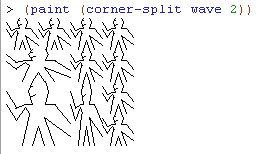
Change the pattern constructed by corner-split (for example, by using only one copy of the up-split and right-split images instead of two).

For this requirement we need to work in the middle layer of abstraction. To use only one copy of the up-split and right-split images instead of two, we can simply remove the references to top-left and bottom-right that appear in the original implementation of corner-split.

(define (corner-split painter n)
(if (= n 0)
painter
(let ((up (up-split painter (- n 1)))
(right (right-split painter (- n 1)))
(corner (corner-split painter (- n 1))))
(beside (below painter up)
(below right corner)))))


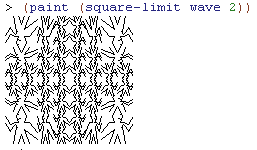
2.52c. Modify the version of square-limit that uses square-of-four so as to assemble the corners in a different pattern. (For example, you might make the big Mr. Rogers look outward from each corner of the square.)

We're not using the Mr. Rogers painter from the text, but we can still rearrange the square-limit painter so that the largest wave image is drawn in the four corners by simply rotating the corner-split painter by 180 degrees.

(define (square-limit painter n)
(let ((quarter (rotate180 (corner-split painter n))))
(let ((half (beside (flip-horiz quarter) quarter)))
(below (flip-vert half) half))))


Related:

For links to all of the SICP lecture notes and exercises that I've done so far, see The SICP Challenge.

Monday, January 2, 2012

SICP 2.50 - 2.51: Transforming and Combining Painters

From SICP section 2.2.4 Example: A Picture Language

Just as we did in exercises 2.44, 2.45, and 2.49, we can use the PLT Scheme SICP Picture Language package to run the solutions to the following exercises. You can load the picture package by putting the following (require...) expression at the beginning of your Scheme file.

(require (planet "sicp.ss" ("soegaard" "sicp.plt" 2 1)))

Exercise 2.50 asks us to define the transformation flip-horiz, which flips painters horizontally, and transformations that rotate painters counterclockwise by 180 degrees and 270 degrees.

We're expected to use the transform-painter procedure defined earlier in section 2.2.4 of the text. Since we're using the PLT Scheme SICP Picture Language package, we'll be using a version of transform-painter that's defined slightly differently than the one in the text. This procedure does not take the painter to be transformed as an argument, as does the version given in the text. Instead it takes the points that specify the corners of the new frame as arguments and returns a procedure that takes the painter as its argument.

For example, instead of defining flip-vert as:
(define (flip-vert painter)
(transform-painter painter
(make-vect 0.0 1.0) ; new origin
(make-vect 1.0 1.0) ; new end of edge1
(make-vect 0.0 0.0))) ; new end of edge2

We would instead pass the painter as an argument to the procedure returned from transform-painter as follows:
(define (flip-vertical painter)
((transform-painter (make-vect 0.0 1.0)
(make-vect 1.0 1.0)
(make-vect 0.0 0.0))
painter))

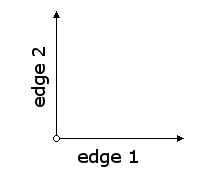
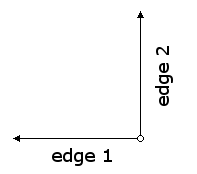
The arguments to transform-painter are points (represented as vectors) that specify the corners of the new frame. The first point specifies the new frame's origin and the other two specify the ends of its edge vectors. Remember that the origin point in a frame is normally in the lower left hand corner. The first edge vector is the bottom edge of frame and the second edge vector is the left edge of the frame.


These edges are defined by the points (0, 0) for the origin, (1, 0) for the end point of the first edge, and (0, 1) for the end point of the second edge. In order to transform a painter we just need to redraw the figure above in the desired orientation, then call transform-painter with the new positions of the origin and the end points of the edges.

To flip a painter horizontally we just move the origin and left edge to the right.


This gives the bottom edge a new endpoint as well. The procedure (based on flip-vert) would be:
(define (flip-horizontal painter)
((transform-painter (make-vect 1.0 0.0) ; origin
(make-vect 0.0 0.0) ; corner1
(make-vect 1.0 1.0)) ; corner2
painter))

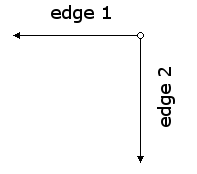
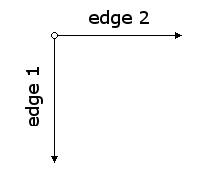
The following images show the locations of the origin and edges when we rotate an image counterclockwise by 180 and 270 degrees.


We can implement the procedures using the origin and endpoints shown in the figures above.
(define (rotate-180 painter)
((transform-painter (make-vect 1.0 1.0)
(make-vect 0.0 1.0)
(make-vect 1.0 0.0))
painter))

(define (rotate-270 painter)
((transform-painter (make-vect 0.0 1.0)
(make-vect 0.0 0.0)
(make-vect 1.0 1.0))
painter))

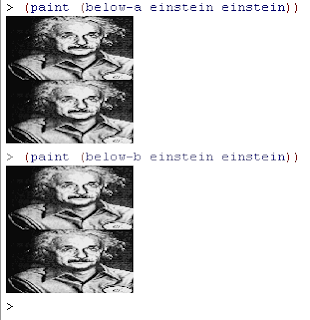
Use the einstein painter provided by the PLT Scheme SICP Picture Language package to check the output of the procedures above.


Exercise 2.51 asks us to define the below operation for painters. The below procedure takes two painters as arguments. The resulting painter draws the first painter in the bottom of the frame and the second painter in the top. We're asked to define below in two different ways -- first by writing a procedure that is analogous to the beside procedure given in the text, and again in terms of beside and suitable rotation operations like the ones we defined in exercise 2.50.

Translating the beside procedure from the text to create the first below procedure is a simple matter of applying what we learned in exercise 2.50 above.
(define (beside painter1 painter2)
(let ((split-point (make-vect 0.5 0.0)))
(let ((paint-left
(transform-painter painter1
(make-vect 0.0 0.0)
split-point
(make-vect 0.0 1.0)))
(paint-right
(transform-painter painter2
split-point
(make-vect 1.0 0.0)
(make-vect 0.5 1.0))))
(lambda (frame)
(paint-left frame)
(paint-right frame)))))

The beside procedure first defines a split-point at the bottom center of the frame that splits the frame vertically. It then transforms the two painters provided so that they each fit into one half of the frame. Finally, it returns a procedure that, when given a frame, paints the two images in the left and right halves of the frame. Here's the analogous below procedure:
; 2.51a
(define (below-a painter1 painter2)
(let ((split-point (make-vect 0.0 0.5)))
(let ((paint-bottom
((transform-painter (make-vect 0.0 0.0)
(make-vect 1.0 0.0)
split-point)
painter1))
(paint-top
((transform-painter split-point
(make-vect 1.0 0.5)
(make-vect 0.0 1.0))
painter2)))
(lambda (frame)
(paint-bottom frame)
(paint-top frame)))))

We need to redefine the split-point so that it divides the frame horizontally instead of vertically. We then transform the painters so that they fit into the bottom and top halves of the frame. Finally, we return a procedure that draws the two halves.

The second implementation of below is even simpler than the first. We just need to draw the two painters beside each other then rotate the frame by 90 degrees. When we do that the two images will be draw on their side, so we need to rotate the individual images 90 degrees in the opposite direction inside their smaller frames. This is equivalent to rotating them 270 degrees in the same direction.
; 2.51b
(define (rotate-90 painter)
((transform-painter (make-vect 1.0 0.0)
(make-vect 1.0 1.0)
(make-vect 0.0 0.0))
painter))

(define (below-b painter1 painter2)
(rotate-90 (beside (rotate-270 painter1) (rotate-270 painter2))))

Once again, we can test with einstein to verify that these two procedures both give us the desired output.


Related:

For links to all of the SICP lecture notes and exercises that I've done so far, see The SICP Challenge.

Sunday, October 9, 2011

SICP 2.49: Defining Primitive Painters

From SICP section 2.2.4 Example: A Picture Language

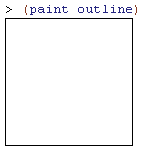
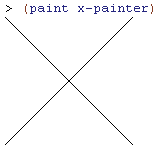
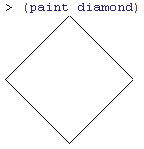
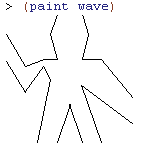
Exercise 2.49 asks us to use segments->painter to define the following primitive painters:

  1. The painter that draws the outline of the designated frame.
  2. The painter that draws an "X'' by connecting opposite corners of the frame.
  3. The painter that draws a diamond shape by connecting the midpoints of the sides of the frame.
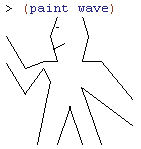
  4. The wave painter.

Just as we did in exercises 2.44 & 2.45, we can use the PLT Scheme SICP Picture Language package to run the exercises. You can load the picture package by putting the following (require...) expression at the beginning of your Scheme file.
(require (planet "sicp.ss" ("soegaard" "sicp.plt" 2 1)))

Since segments->painter takes a list of segments as its input parameter, each solution is just a matter of figuring out the coordinates of the endpoints of each required segment. Recall that the (0.0, 0.0) coordinate is the bottom left corner in the frame, not the top left corner as it is in many GUI environments. For each solution, we can define the list of segments first, then define a painter.
; 2.49 a.
; The painter that draws the outline of the designated frame.
(define outline-segments
(list
(make-segment
(make-vect 0.0 0.0)
(make-vect 0.0 0.99))
(make-segment
(make-vect 0.0 0.0)
(make-vect 0.99 0.0))
(make-segment
(make-vect 0.99 0.0)
(make-vect 0.99 0.99))
(make-segment
(make-vect 0.0 0.99)
(make-vect 0.99 0.99))))

(define outline (segments->painter outline-segments))

Note that I used 0.99 instead of 1.0 for the edges of the frame. This is because the top and right edges won't be displayed if you use 1.0.


; 2.49 b.
; The painter that draws an ``X'' by connecting opposite corners of the frame.
(define x-segments
(list
(make-segment
(make-vect 0.0 0.0)
(make-vect 0.99 0.99))
(make-segment
(make-vect 0.0 0.99)
(make-vect 0.99 0.0))))

(define x-painter (segments->painter x-segments))


; 2.49 c.
; The painter that draws a diamond shape by connecting the midpoints of the sides of the frame.
(define diamond-segments
(list
(make-segment
(make-vect 0.0 0.5)
(make-vect 0.5 0.0))
(make-segment
(make-vect 0.0 0.5)
(make-vect 0.5 0.999))
(make-segment
(make-vect 0.5 0.999)
(make-vect 0.999 0.5))
(make-segment
(make-vect 0.999 0.5)
(make-vect 0.5 0.0))))

(define diamond (segments->painter diamond-segments))


The wave painter in the last part of the exercise is the image shown in Figure 2.10 of the text. It consists of 17 separate segments.
; 2.49 d.
; The wave painter.
(define wave-segments
(list
(make-segment
(make-vect 0.006 0.840)
(make-vect 0.155 0.591))
(make-segment
(make-vect 0.006 0.635)
(make-vect 0.155 0.392))
(make-segment
(make-vect 0.304 0.646)
(make-vect 0.155 0.591))
(make-segment
(make-vect 0.298 0.591)
(make-vect 0.155 0.392))
(make-segment
(make-vect 0.304 0.646)
(make-vect 0.403 0.646))
(make-segment
(make-vect 0.298 0.591)
(make-vect 0.354 0.492))
(make-segment
(make-vect 0.403 0.646)
(make-vect 0.348 0.845))
(make-segment
(make-vect 0.354 0.492)
(make-vect 0.249 0.000))
(make-segment
(make-vect 0.403 0.000)
(make-vect 0.502 0.293))
(make-segment
(make-vect 0.502 0.293)
(make-vect 0.602 0.000))
(make-segment
(make-vect 0.348 0.845)
(make-vect 0.403 0.999))
(make-segment
(make-vect 0.602 0.999)
(make-vect 0.652 0.845))
(make-segment
(make-vect 0.652 0.845)
(make-vect 0.602 0.646))
(make-segment
(make-vect 0.602 0.646)
(make-vect 0.751 0.646))
(make-segment
(make-vect 0.751 0.646)
(make-vect 0.999 0.343))
(make-segment
(make-vect 0.751 0.000)
(make-vect 0.597 0.442))
(make-segment
(make-vect 0.597 0.442)
(make-vect 0.999 0.144))))

(define wave (segments->painter wave-segments))


Related:


For links to all of the SICP lecture notes and exercises that I've done so far, see The SICP Challenge.