Saturday, March 25, 2017
10-digit Number
Find a 10-digit number where the first digit is how many 0's there are in the number, the second digit is how many 1's in the number, the third digit is how many 2's, and so on, until the tenth digit which is how many 9's there are in the number.
Click below to see the answer.
Saturday, March 18, 2017
The Extra Dollar
Here is an old math puzzle that you can find many versions of online.
Two friends have a meal at a restaurant, and the bill is $25. The friends pay $15 each, which the waiter gives to the cashier. The cashier gives back $5 to the waiter. The friends tell the waiter to keeps $3 as a tip, so he hands back $1 to each of the two diners.
So, the friends paid $14 each for the meal, for a total of $28. The waiter kept $3, and that makes $31. Where did the extra dollar come from? Give yourself a moment to think about it before clicking below for the solution.
$25 is sitting with the cashier, $2 is back with the diners, and $3 is with the waiter. That adds to the required $30, so there really is no extra dollar.
The mistake is expecting that what the diners paid and what the waiter kept to add up to what they initially gave. Adding $28 and $3 is just a bit of sleight-of-hand. It's the amount that the meal effectively cost them (including tip), plus the amount they received back, that should add to $30.
Labels:
logic puzzles,
numbers
Saturday, March 11, 2017
Arranging Eights
Can you arrange eight 8's so that when added they will equal 1000? Click below to see the answer.
It's certainly possible to try all 22 different ways to partition eight identical digits, but there is a shortcut.
All of the numbers that are created by arranging eight 8's will end in the digit 8, and the sum of the last digits of those numbers must be a multiple of 10 (because the target sum of 1000 ends in 0), so we know there must be exactly five groups of digits in the correct solution. That means we only have to check 3 different partitions of the eight digits.
8888 + 8 + 8 + 8 + 8
888 + 88 + 8 + 8 + 8
88 + 88 + 88 + 8 + 8
These are the only three ways to partition eight identical objects into five groups, and they are the only groupings whose sums end in the digit 0. You can check with quick mental arithmetic that the second grouping is the correct solution.
All of the numbers that are created by arranging eight 8's will end in the digit 8, and the sum of the last digits of those numbers must be a multiple of 10 (because the target sum of 1000 ends in 0), so we know there must be exactly five groups of digits in the correct solution. That means we only have to check 3 different partitions of the eight digits.
8888 + 8 + 8 + 8 + 8
888 + 88 + 8 + 8 + 8
88 + 88 + 88 + 8 + 8
These are the only three ways to partition eight identical objects into five groups, and they are the only groupings whose sums end in the digit 0. You can check with quick mental arithmetic that the second grouping is the correct solution.
Saturday, March 4, 2017
A Unique Number
What is unique about the number 8,549,176,320? Click below to see the answer (and a bonus question).
There's nothing numerically particularly unique or interesting about the number above. It is made up of all of the digits from 0 to 9, but a lot of numbers have that property. The unique thing about this number is that all of the digits from 0 to 9 are in alphabetical order when spelled out in English.
Bonus question: Can you think of a number whose letters when spelled out in English are all in alphabetical order? Example: The first three letters of the word "five" are in alphabetical order, but the "e" at the end spoils it.
Labels:
brain teasers,
numbers,
puzzles
Saturday, February 25, 2017
Best Poker Hand
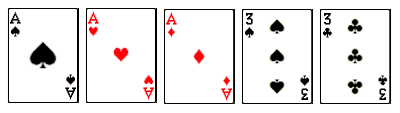
Which of the following poker hands is the best? Assume one standard 52-card deck is used. The game is five-card draw, so there are no community cards, with no wild cards.
For reference, here are the rankings of poker hands.
- Royal flush - A, K, Q, J, 10, all the same suit.
- Straight flush - Five cards in a sequence, all the same suit.
- Four of a kind - Four cards all of the same rank.
- Full house - Three of a kind with a side pair.
- Flush - Any five cards, all the same suit
- Straight - Five cards in a sequence, any suits.
- Three of a kind - Three cards all of the same rank.
- Two pair - Two different pairs.
- One pair - Two cards of the same rank.
- High card - Highest card in your hand.
Click below to see the answer.
Hand #1 is the highest-ranking hand shown, but since all of these hands cannot occur on the same deal, it isn't the best hand to have in a real game.
To determine which hand is best, you have to look at how many other hands can beat each hand when dealt from the same deck. All of the hands above can be beaten by the same number of four-of-a-kinds, but by different numbers of straight flushes. Having two sixes as your side pair breaks up more of these possible straight flushes than having two kings, so hand #4 is actually the best hand to have. (There are 32 possible straight flushes that beat the kings hand, but only 24 that beat the sixes.)
Labels:
brain teasers,
logic,
puzzles
Saturday, February 18, 2017
The Collapsing Bridge
The bridge will collapse in 17 minutes! Four people need to cross the bridge before it collapses. It is a dark night and they have only one flashlight among them.
Only two people can cross at a time.
- Alice takes one minute to cross.
- Bob takes two minutes.
- Carol takes five minutes
- Dave takes 10 minutes to cross.
The trick to this puzzle is to get the slowest members of the group to cross only once together, while the fastest members cross back and forth multiple times.
- Alice and Bob cross first using up 2 minutes.
- Alice comes back making it 3.
- Carol and Dave cross together making it 13 minutes.
- Then Bob crosses back, making it 15 minutes.
- Finally, Alice and Bob cross together to make it a total of 17 minutes.

Labels:
brain teasers,
logic puzzles,
math
Friday, February 10, 2017
The Island of Knights and Knaves
Raymond Smullyan, one of the grand masters of logic puzzles, sadly passed away at the age of 97 earlier this week. In his honor, I present a classic puzzle adapted from his book What Is the Name of This Book?
There is a wide variety of puzzles about an island in which certain inhabitants called "knights" always tell the truth and others called "knaves" always lie. It is assumed that every inhabitant of the island is either a knight or a knave.
In this problem, there are only two people, A and B, each of whom is either a knight or a knave. A makes the following statement: "At least one of us is a knave." What are A and B?
Click below for the solution.
The solutions to these puzzles are often found by making one or more assumptions, then reasoning out whether or not it can be true. In this case, assume A is a knave. Then the statement "At least one of us is a knave" would be false, since knaves always lie. Hence, both A and B would be knights, which is impossible because we started with the assumption that A is a knave. Therefore, A must be a knight, and the statement "At least one of us is a knave" must be true, and B is a knave.
Raymond Smullyan presented a couple more of his puzzles in a 1982 interview on the Tonight Show with Johnny Carson. When you see the white hair and long beard, it seems like even 35 years ago that Smullyan was an old man, but the twinkle in his eye and the playfulness in his voice reveal that he was always a child at heart. Watch the full interview below.
If these puzzles seem too easy, they're just a small sample of Dr. Smullyan's brilliant work. If you really want a challenge, I encourage you to check out some of his books, or The Hardest Logic Puzzle Ever, also credited to Smullyan.
Finally, I leave you with a quote.
Why should I be worried about dying?
It's not going to happen in my lifetime!
-Raymond Smullyan (1919 - 2017)
Labels:
logic puzzles,
smullyan
Subscribe to:
Posts (Atom)